
A multi-tenant ERP for three cutting-tool manufacturers Zoho could not hold.
Three cutting-tool manufacturers in Mumbai outgrew Zoho. We built CFX, a custom multi-tenant ERP on AWS with a dedicated Android sales app and Gemini AI integration.

Student progress, contributions, payroll, receipts, refunds, and a custom WhatsApp chat layer. One operating system for a community institution that runs on goodwill.
Qism-Al-Tahfeez Madras is a Quran memorization institute in Chennai. Their work is the patient, multi-year process of helping students commit the text of the Quran to memory under structured guidance. The teachers are skilled. The community supports the institute through voluntary contributions. The institution has run for years on goodwill, relationships, and the personal effort of the people leading it.
The brief was to take the operational load off the people running the institute so that their attention could remain on the work the institute exists to do.
A community institution of this kind runs many simultaneous workflows that, individually, are not complicated, but in aggregate consume considerable time. Students enrol. They progress through portions of the text at their own pace. Their progress needs to be tracked. Teachers attend, teach, and need to be paid. The institute's running cost is covered by voluntary contributions from families and from the wider community, which need to be invoiced, collected, receipted, and acknowledged. Occasionally a contribution needs to be waived or refunded, which requires admin approval. Communication with families happens primarily over WhatsApp, because that is where the community lives.
Before the system, all of this happened by hand or in spreadsheets and notebooks. The teachers tracked progress on paper. The admin tracked contributions in a ledger. WhatsApp messages went out individually. Reminders depended on whoever was responsible remembering to send them. The administrator's time was largely spent doing the operational work that the system now does.
A web application designed around the institute's day-to-day reality.
Each student has a profile that captures their enrolment details, their assigned teacher, the course they are following, and their progress through the memorisation curriculum. Teachers update progress after each session. The administrator and the family can see where the student is without asking.
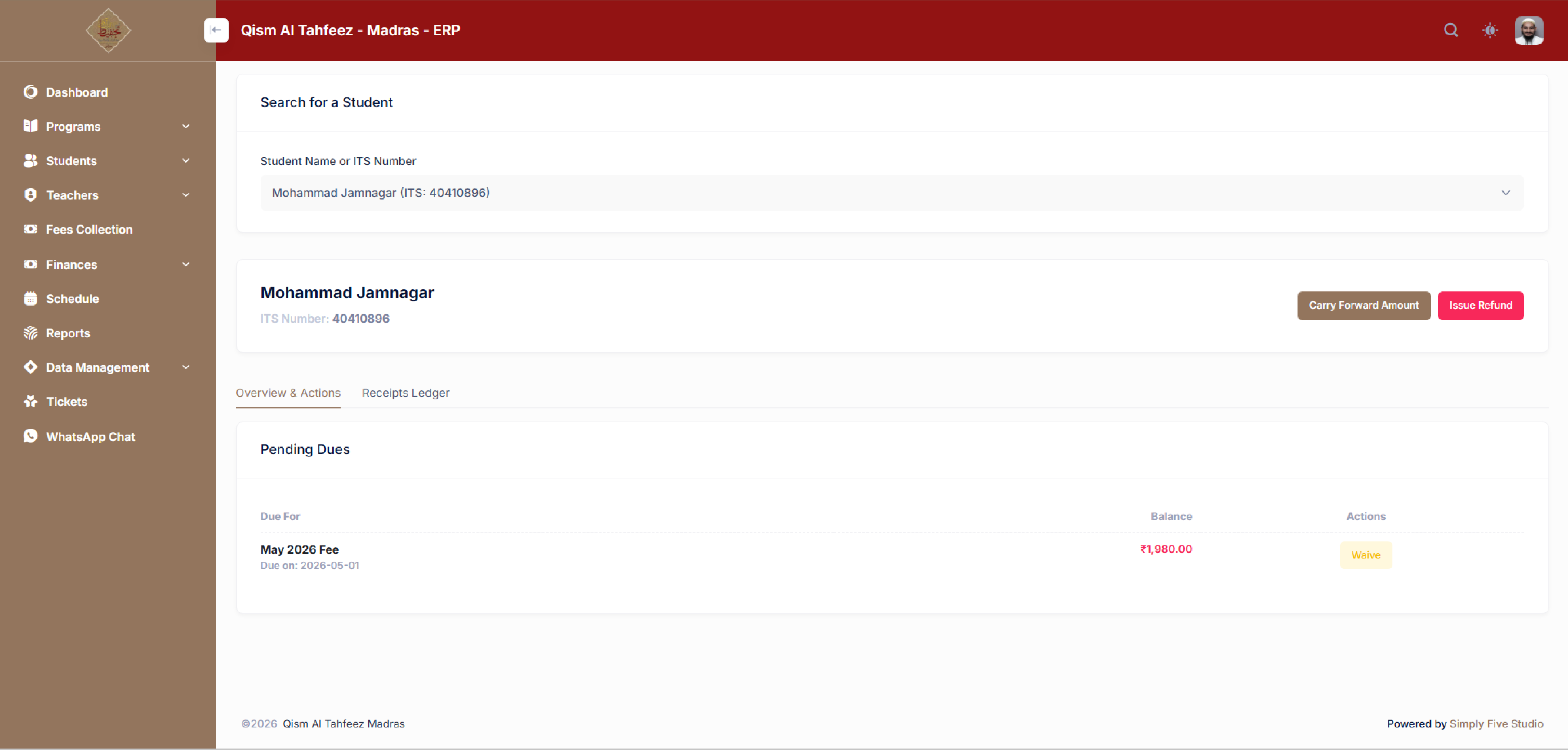
The system generates monthly dues automatically. Families receive their invoices through WhatsApp and email. Payment status is tracked. Receipts are issued automatically when payments arrive, and the receipt PDF is delivered through the same channels as the invoice.
Teachers register their attendance. The system computes payroll from attendance against the agreed rate per teacher. Approval workflows surface any exceptions to the administrator before payment is released. What used to be a monthly reconciliation exercise is now an auto-generated report that the administrator reviews and signs off on.
Cumulative income and expense reports give the institute's leadership a month-by-month view of the financial picture. Contribution patterns, cost trends, teacher productivity, and student attendance all surface in a single view. The trustees who oversee the institute can see how it is running without depending on a manual monthly report.
Due waivers for families in difficulty. Refund processing for over-paid contributions. Configuration of fee structures as they change. The administrative actions that previously required out-of-system processes now sit inside the system with proper audit trails.
A first-party WhatsApp messaging layer built directly on the WhatsApp Cloud API. No BSP middleware. The institute can send broadcast messages, respond to inbound messages, and run structured conversations from inside the application. The messaging is integrated with the student and family records, which means every conversation has context.
This last piece is structurally important. Most institutions either use a generic broadcast tool that does not connect to their operational data, or pay a BSP a per-message fee for capabilities they could own outright. The direct integration removes both compromises.
A family enrols their child. The student record is created. The teacher who will oversee the student's progress is assigned. The monthly contribution amount is set. From that point forward, the family receives their invoice on the first of each month, pays through their preferred channel, and receives an automated receipt. Reminders go out for overdue contributions without anyone needing to track them manually.
The teacher logs the student's progress after each session. The administrator can see at a glance which students are progressing well and which need attention. The trustees see a financial dashboard each month that summarises the institute's position.
When an exception arises (a family in financial difficulty, a teacher's attendance discrepancy, a refund request), the administrator handles it through the admin tools rather than through a separate process. Everything sits inside the same operational record.
The administrator's time, previously consumed by the operational mechanics of running the institute, became available for the institute's actual mission. The trustees' financial visibility, previously dependent on a manual report, became continuous. The families' experience of interacting with the institute became more professional without losing the warmth that community institutions thrive on.
A subtle but real effect was on accountability. When financial and operational records are in one place and easy to read, governance becomes easier. Trustees can answer questions from the community confidently. Donors can see how the institution is being run. This kind of transparency builds trust over time, which for a community institution is the most valuable asset.
The system continues to evolve on an ongoing support engagement. Recent additions include deeper WhatsApp automation, additional reporting views, and refinements to the receipts and reminders flow. The work continues at a rhythm that matches the institute's needs.
Three cutting-tool manufacturers in Mumbai outgrew Zoho. We built CFX, a custom multi-tenant ERP on AWS with a dedicated Android sales app and Gemini AI integration.
Evrnest Vista Associate sells property for Chennai developers and Danube Properties, Dubai. We built the system the desk and the field run on: leads from Meta ads and walk-ins, two books of inventory, developer mandates, WhatsApp, a calendar, and a bilingual public site that turns a saved property into a lead.
Lucky Traders counted their godown on paper. We built a Tauri app for Windows and Android that gives every bag of fasteners its own QR sticker, scans it out with nothing to type, keeps working without a signal, and hears the barcode gun even while Tally is on screen.
Engagements begin with a conversation. Not a pitch. A direct discussion about your operations and the visibility you are missing.